
If you are in need of a new website, a popular search question that probably wouldn’t have even crossed your mind a few years ago:
Should I build my website using AI, or should I pay a website designer or developer to build it for me?
It’s a fair question.
AI website builders promise to create a website in minutes. Some are incredibly cheap compared with employing a professional website designer. You can describe your business, choose a few options and potentially have something resembling a finished website before you’ve finished your coffee.
But is that actually comparable to having a website professionally designed?
What happens when you want the website to look exactly like your brand? Who hosts it? Where do your emails come from? What happens when something breaks? Can you add Google Analytics, advertising tracking, forms or ecommerce later?
And importantly, will an AI-built website actually perform on Google?
As someone who builds websites and works in digital marketing, I’m obviously looking at this from the perspective of a website developer. We have had a sharp rise in customers coming to us needing us to fix or rebuild their AI website.
I think there are situations where building your own website with AI makes complete sense, but the important thing to understand before you make this decision is to consider what you are actually comparing.
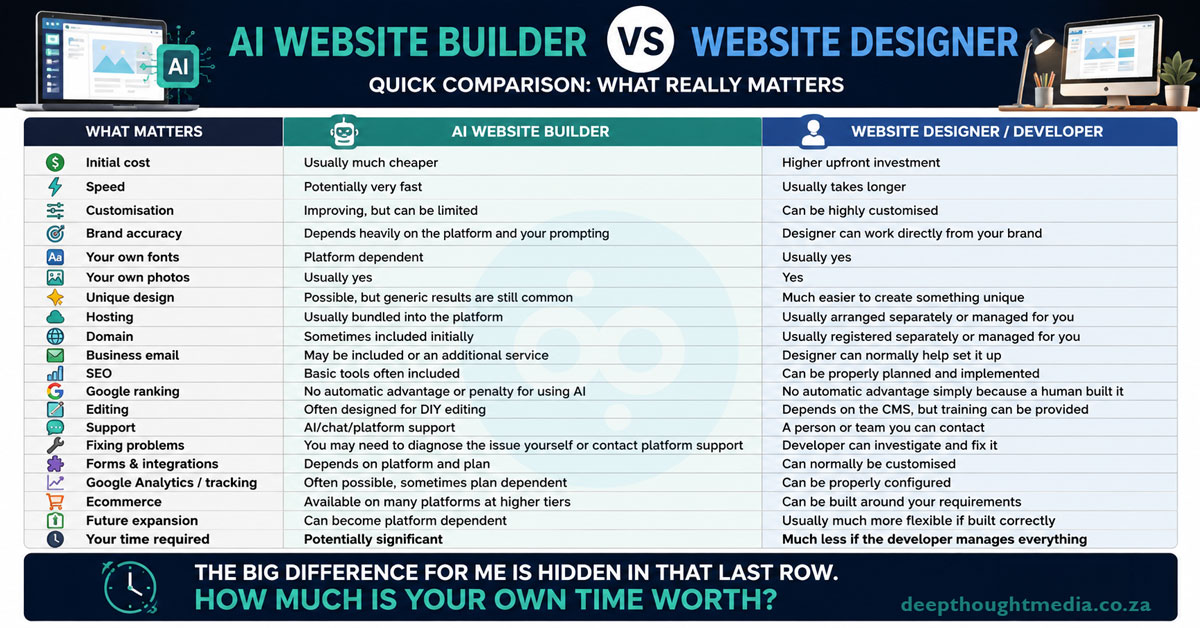
AI Website Builder vs Website Designer: Quick Comparison
| What matters | AI Website Builder | Website Designer / Developer |
| Initial cost | Usually much cheaper | Higher upfront investment |
| Speed | Potentially very fast | Usually takes longer |
| Customisation | Improving, but can be limited | Can be highly customised |
| Brand accuracy | Depends heavily on the platform and your prompting | Designer can work directly from your brand |
| Your own fonts | Platform dependent | Usually yes |
| Your own photos | Usually yes | Yes |
| Unique design | Possible, but generic results are still common | Much easier to create something unique |
| Hosting | Usually bundled into the platform | Usually arranged separately or managed for you |
| Domain | Sometimes included initially | Usually registered separately or managed for you |
| Business email | May be included or an additional service | Designer can normally help set it up |
| SEO | Basic tools often included | Can be properly planned and implemented |
| Google ranking | No automatic advantage or penalty for using AI | No automatic advantage simply because a human built it |
| Editing | Often designed for DIY editing | Depends on the CMS, but training can be provided |
| Support | AI/chat/platform support | A person or team you can contact |
| Fixing problems | You may need to diagnose the issue yourself or contact platform support | Developer can investigate and fix it |
| Forms & integrations | Depends on platform and plan | Can normally be customised |
| Google Analytics / tracking | Often possible, sometimes plan dependent | Can be properly configured |
| Ecommerce | Available on many platforms at higher tiers | Can be built around your requirements |
| Future expansion | Can become platform dependent | Usually much more flexible if built correctly |
| Your time required | Potentially significant | Much less if the developer manages everything |
The big difference for me is hidden in that last row. How much is your own time worth?
Should I Build My Website with AI or Hire a Website Designer?
My answer today would depend on what you need.
Consider an AI website builder if:
• Your budget is extremely limited.
• You need something online very quickly.
• Your website requirements are relatively simple.
• You enjoy doing things yourself.
• You’re comfortable learning new software.
• You’re willing to spend your own time refining it.
• You’re comfortable managing the technical side yourself.
• You’re experimenting with a new idea or business.
• Having something online is currently more important than having something completely customised.
Consider a website designer or developer if:
• Your website is important to your business.
• You want the website to accurately represent your brand.
• You require something highly customised.
• You want professional input on design and UX.
• SEO is important to your business.
• You’re running Google Ads or other digital advertising.
• You need accurate analytics and conversion tracking.
• You need integrations, ecommerce or advanced functionality.
• You want someone available when things go wrong.
• You don’t want to spend your own time becoming your company’s website technician.
As a Professional Web Designer of More Than 10 Years – My Personal View on AI Websites
AI website builders are impressive. And they’re going to get much better. Right now you can spot them a mile away.
I wouldn’t be surprised if my answer to this question looks very different in another two or three years.
But right now, I don’t believe most cheap or entry-level AI website builders consistently compete with a good website designer when the objective is to create a highly personalised, accurate representation of a business and its brand.
They can create a website. That’s not necessarily the same thing as creating YOUR website.
At the higher end, when you combine better AI platforms with someone who understands prompting, development, branding, UX and SEO, the gap becomes much smaller. But that requires knowledge.
For me, the best approach right now isn’t necessarily AI or a website developer. It’s a good website developer using AI intelligently.
You get the speed and capabilities AI can offer while retaining the experience, judgement, creativity, accountability and personal service of someone who understands your business.
And importantly, when something goes wrong, you’ve still got a human being you can call.
How Does Building a Website with AI Actually Work?
The exact process differs between platforms, but generally an AI website builder asks you questions about your business.
You might tell it: “I own a plumbing company in Cape Town. Create a professional five-page website with Home, About, Services, Projects and Contact pages.”
The AI generates a layout, text, imagery, colours and other website elements based on your instructions.
You can then continue editing the website, either using prompts or a visual website editor.
Some platforms now combine AI generation with traditional drag-and-drop website building. So these aren’t simply experimental toys anymore. The technology is becoming increasingly capable.
But generating a website and creating the right website are two different things.
The Value of Having a Human Being Behind Your Website
This is ultimately where I currently see the biggest difference.
A website designer is providing a service, not simply software.
You can speak to them. They can learn about your business. They can understand your brand. They can advise you. They can tell you when something is a bad idea. They can make something very specific to you.
They can configure your email. They can help with hosting. They can install tracking. They can add a page. They can fix the contact form. They can investigate why something suddenly stopped working.
And hopefully, if you’ve found someone you trust, you don’t need to understand any of it yourself.
You can focus on running your business. That has value.
Will AI Build My Website Exactly How I Want It?
This is currently one of my biggest reservations.
AI is very good at getting you somewhere. It isn’t always very good at getting you exactly where you wanted to go.
You might ask for something and get 70% or 80% of the way there remarkably quickly. You then spend a disproportionate amount of time trying to correct the remaining details.
Move this. Make that smaller. That’s the wrong font. Don’t change that section. Use this image instead. Make the mobile version different. No, not like that. Put it back.
Anyone who uses AI regularly will probably recognise that experience.
If you have a very clear understanding of prompting, web design, UX, branding and the platform you’re working with, you can potentially produce something very good.
But that introduces another question: If you need to understand web design, SEO, hosting, domains, DNS, email, analytics, UX and AI prompting to get the result you want, how much of the web developer’s job have you actually eliminated?
Can an AI Website Use My Branding, Fonts and Photos?
Potentially, yes.
Many AI website platforms allow you to upload your logo, photographs and other assets and customise colours and fonts.
But there is a difference between using your branding and understanding your brand.
A designer can look at your existing marketing material, logo, photography, products, competitors, target market and business goals and interpret those things visually.
They can ask questions: Why do you like this? Why don’t you like that? Who are your customers? What do you want someone to do when they arrive on the website? What makes you different from your competitors?
AI can be given this information too, but someone still needs to provide it, evaluate the output and keep refining it. This is one of the areas where I think the human element remains incredibly important.
Can You Tell When a Website Was Built with AI?
In my opinion, currently, yes.
Not every time, obviously, and this will probably change very quickly.
But right now, I think you can spot many AI websites a mile away.
They often have the same polished but slightly generic feel. Similar structures, similar stock-style or AI imagery, similar headings and very similar language.
Everything technically looks good. But nothing feels particularly specific.
That matters because your website is often someone’s first meaningful interaction with your business.
A professionally designed website should feel like your company, not simply like a nice website with your logo placed at the top.
Will Customers React Negatively to an AI Website?
This is an interesting question and one businesses should at least consider.
We’re already seeing a growing amount of AI-generated advertising, social media artwork, photographs and flyers. I’ve personally noticed how quickly people on social media identify AI-generated creative, and the reaction isn’t always positive.
There seems to be some fatigue developing around businesses pumping out obvious AI content.
Does that mean someone will refuse to buy from you because your website was built using AI? Possibly.
But if the website feels cheap, generic or impersonal, that absolutely can influence someone’s perception of the business.
The issue isn’t necessarily that AI made it. The issue is whether it looks like AI made it. There is an important difference.
Does Google Penalise AI-Built Websites?
This is one of the biggest misconceptions around AI websites.
Google does not automatically penalise a website simply because AI was used to create it.
Google’s guidance focuses on the quality and usefulness of the website and its content, rather than simply whether AI was involved in creating it.
The same basic SEO principles still apply. Your website needs useful and original content, a sensible structure, crawlable pages, good performance, mobile usability and a good experience for visitors.
So being built by AI is not automatically an SEO disadvantage. But being built badly certainly can be.
What About AI-Written Website Content and SEO?
There is nothing inherently wrong with using AI to help write website content. We use AI ourselves.
But I don’t think businesses should simply ask AI to “write SEO content for my plumbing company” and publish whatever comes back.
That is exactly how the internet becomes filled with thousands of websites saying essentially the same thing.
Your website should contain things AI doesn’t automatically know: your experience, your projects, your customers, your photographs, your locations, your processes, your expertise, your opinions, your pricing where appropriate, FAQs based on questions customers actually ask, case studies, your people and your story.
AI can help structure and improve that information. But the business itself is where the valuable information should originate.
Will an AI Website Rank on Google?
It absolutely can.
But an AI website builder having an “SEO” button or an “AI SEO tool” does not mean your SEO has been taken care of.
SEO involves considerably more than inserting some keywords into a page.
• Keyword and search-intent research
• Website architecture
• Page targeting
• Titles and meta descriptions
• Heading structures
• Internal linking
• Image optimisation
• Local SEO
• Google Business Profile
• Schema and structured data
• Search Console
• Google Analytics
• Page speed
• Mobile performance
• Indexing and crawlability
• Redirects
• Duplicate content
• Conversion tracking
• Ongoing content
• Competitor analysis
AI can help with many of these tasks. But someone still needs to know that they need doing.
Who Hosts My AI Website?
This depends on the platform.
Many AI website builders operate as an all-in-one service where your website builder and hosting are bundled together. That can be a major advantage for someone who wants simplicity.
However, you need to understand what happens if you eventually want to leave. Can you move your website somewhere else? Can you export everything? Do you own the website itself or are you effectively renting access to the platform that runs it? What happens to your website when you stop paying?
These are questions worth asking before building the website rather than three years later when you want to move it.
What Does an AI Website Actually Cost?
This is where AI website builders can be extremely attractive.
Entry-level AI website platforms can be very inexpensive, although promotional pricing can be very different from renewal pricing.
Some packages bundle together website building, hosting, SSL, domain registration for an initial period, email accounts, AI tools, basic SEO tools, analytics and ecommerce features.
But check the renewal cost carefully. A package advertised at a very low monthly rate might require you to pay several years upfront and renew later at a substantially higher rate.
Also check whether the feature you actually need is included. The cheap package isn’t cheap anymore if you subsequently discover you need a higher package for ecommerce, additional email addresses, analytics, integrations or other functionality.
Website Designer Costs: Once-Off vs Recurring
Hiring a professional generally involves a much larger upfront cost. You’re paying for someone’s time, knowledge, design ability and technical experience.
There are then recurring costs that could include domain renewal, website hosting, email hosting, website maintenance and additional development.
The important thing when comparing AI and professional website costs is to compare the total cost, not simply:
AI = monthly fee; Designer = expensive website.
What About My Business Emails?
This is one of those things that seems completely unrelated to web design until you need to launch a website.
You want name@yourbusiness.co.za. Now what?
Where is that email hosted? How do you get it onto Outlook? How do you add it to your phone? What are the incoming and outgoing server settings? What happens to your existing email when your website moves? Who changes your DNS records? Are your MX records correct?
This is where having an actual person managing your website can suddenly become extremely valuable.
A good website company doesn’t simply hand you a website and disappear. They help connect the pieces.
What Happens When My AI Website Breaks?
This would be high on my list of questions before choosing an AI platform.
Who do I contact? And perhaps more importantly: How quickly can they fix it? (For one thing, you can contact Deep Thought Media, we are experts at website design and fixing or rebuilding AI built websites.
You might have access to AI support, documentation, a chatbot or 24/7 platform support. That could be perfectly adequate.
But when your contact form stops working on Friday afternoon and your Google Ads campaign is sending paid traffic to it, you don’t particularly want to spend your evening learning how forms work.
You want to send someone a message saying: “Our form isn’t working. Can you please take a look?”
That’s part of what you’re paying a website company for. Not just building the website. Taking responsibility for it.
Can I Edit My AI Website Myself?
Usually, yes, and this is actually one of the biggest benefits.
Most modern AI website builders are specifically designed for people without coding experience. You can change copy, replace images, create sections and potentially generate entire pages using AI.
But easy is relative.
A website designer using WordPress or another CMS can also give you access to edit your website and provide training.
The question therefore isn’t simply: Can I edit it? It’s: How much control do I have when I edit it?
What Happens When My Website Needs to Grow?
Your website today might only need five pages.
Two years from now you might want online bookings, a customer portal, online payments, a members area, a multilingual website, a large product catalogue, advanced forms, CRM integration, email marketing integration, Google Ads conversion tracking, Meta Pixel, TikTok Pixel, WhatsApp functionality, live chat, API integrations, custom databases, or something that hasn’t even been invented yet.
This is where platform choice becomes important.
Before committing to an AI website builder, I would look at what it can become rather than simply what it can do today.
Can I Add Google Analytics, Google Ads Tracking and Meta Pixel?
Often yes, but check before committing to the platform.
For businesses actively marketing online, this isn’t optional.
At minimum, you may eventually need Google Analytics 4, Google Search Console, Google Tag Manager, Google Ads conversion tracking and Meta Pixel. An ecommerce business may require considerably more sophisticated tracking.
Being able to paste in a tracking ID isn’t necessarily the same thing as having tracking correctly configured.
If you’re spending thousands of Rands every month advertising your business, you want to know whether those campaigns are actually generating enquiries and sales.
Can I Turn My AI Website into an Online Store Later?
Potentially. Many AI website builders now include ecommerce functionality.
But look beyond whether the platform has an Add Product button.
Ask whether it supports the payment provider you want, delivery configuration, stock management, product variations, specials and coupons, ecommerce tracking, advertising integrations, individual product SEO, external integrations and the scale your business may eventually require.
The fact that a platform supports ecommerce doesn’t necessarily mean it supports the ecommerce business you may eventually become.
Where AI Website Builders Make a Lot of Sense
Despite all of the above, I absolutely think there are situations where AI website builders make sense.
If you’re starting a new business with almost no budget and the choice is between having an AI website and having no website, I’d probably choose the AI website.
The same applies to a temporary project, personal website, proof of concept, simple portfolio or small business that genuinely only requires a few pages.
If you understand AI well, understand website design and are prepared to put the time into it, you may also be able to build an excellent website.
And these tools are improving incredibly quickly.
What I’m questioning is whether the cheapest AI website builder should currently be viewed as a direct replacement for a professional website designer. I don’t think we’re there yet.
What About More Advanced AI Website Building?
This is where the comparison becomes much more interesting.
There is a massive difference between asking “Build me a website for my plumbing company” and someone who understands AI, web development, design and prompting using sophisticated AI tools to create and refine a website.
With enough knowledge, time and access to more advanced tools, I think you could build an extremely good website using AI.
But again, look at what has happened. We’ve moved from “Can AI replace the website developer?” to “Can someone who understands web development use AI to build websites faster?”
I think the answer to the second question is absolutely yes. And that’s where I think AI is currently far more powerful.
AI vs Website Designers Doesn’t Have to Be AI vs Humans
This is probably the most important point.
At Deep Thought Media, we don’t see AI as something website designers should avoid. Quite the opposite.
AI is becoming another tool available to designers, developers, SEO specialists and marketers. It can help us research, write and troubleshoot code, develop ideas, analyse websites, structure content, identify problems and dramatically speed up certain parts of development.
But there’s still a person deciding whether the result is right. That distinction matters.
Important FAQ on using AI vs Human to build your website
Is it cheaper to build a website with AI?
Does Google penalise websites built using AI?
No. Google does not automatically penalise a website because AI was used to create it. Google focuses on factors such as usefulness, originality, technical accessibility and overall quality.