
Google Ads or SEO: Which Works Better for SA Businesses?
Every South African business owner with a limited marketing budget eventually hits the same wall. Do you put your rands into Google Ads and get traffic this week, or do you invest in SEO and build something that compounds over time? The debate is loud, and both camps argue passionately. The problem is that framing this as a competition between two channels misses the real question entirely.
If you are asking, “Is Google Ads or SEO better for my South African business?”, the honest answer is that it depends on your budget, your timeline, and what your customers are searching for right now. At Deep Thought Media & Marketing™, we manage both Google Ads campaigns and SEO services for South African businesses across Cape Town and beyond. What we see in the local market does not always match the generic advice you will find online, which is why this guide draws on aggregated South African benchmarks and anonymised agency case data rather than broad international assumptions.
By the end of this article, you will have a clear starting plan, realistic benchmarks, and enough context to begin implementing within 30 days.
The Core Difference: Speed vs Compounding Returns
What Google Ads Actually Buys You
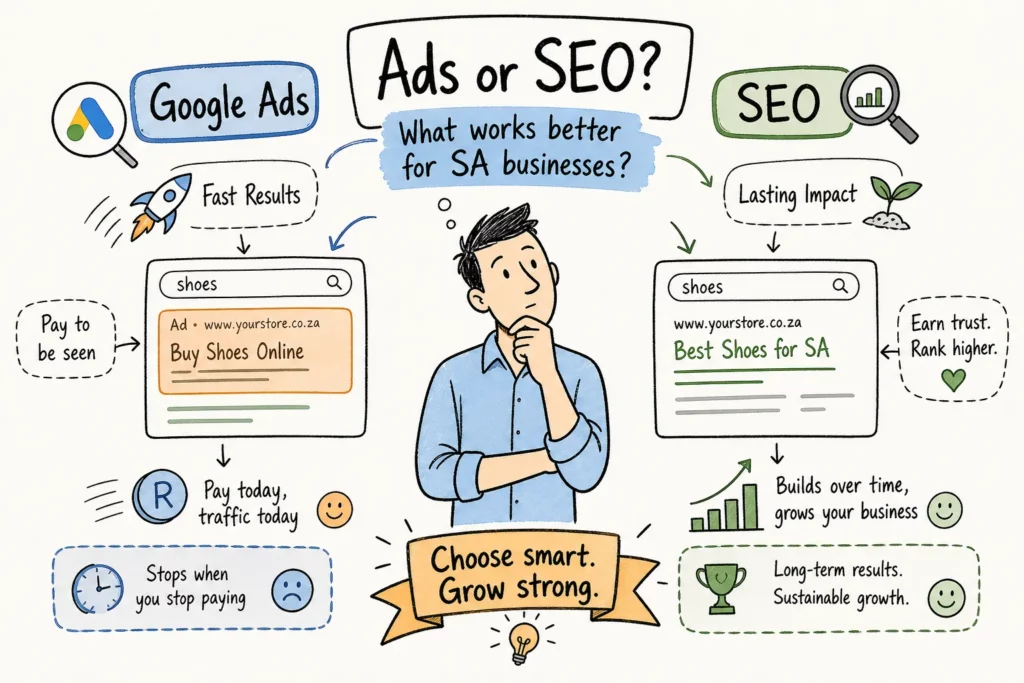
Google Ads places your business at the top of search results the moment your campaign goes live. That is genuinely useful, but it comes with an important caveat: the visibility is rented, not owned. The moment you stop paying, the traffic stops. You are not building an asset. You are buying access to an audience for as long as your budget holds.
That is not a criticism. For certain business situations, rented visibility is exactly what you need, and the pay-per-click (PPC) model at least ties your spend directly to intent-driven traffic rather than impressions nobody acts on.
What SEO Is Actually Building
SEO works on a fundamentally different logic. You are investing in your website’s authority, relevance, and technical health so that Google trusts it enough to rank it organically. Unlike paid ads, those rankings do not vanish when you stop paying a retainer.
The trade-off is time: early months feel slow because results compound. The work done in month two builds on month one, and by month six, traffic growth typically accelerates noticeably. Think of it as a long-term asset on your balance sheet rather than a recurring operating expense.
What Do Google Ads and SEO Cost in South Africa?
Google Ads Budgets and CPCs by Industry
South African CPCs vary significantly depending on your industry. Ecommerce clicks average R5 to R18, home services sit between R12 and R30, and legal services can reach R35 to R85 per click in 2026.
A small local business needs a minimum of R4,000 to R10,000 per month in ad spend just to generate meaningful volume, while growing SMEs typically invest R10,000 to R25,000 per month. Add agency management fees of 10% to 20% of ad spend on top of that.
Budget alone does not determine success, though. A Johannesburg legal practice we tracked in our agency case data was initially paying over R4,000 per lead. After landing page improvements and tighter keyword targeting, that figure dropped to R718 on the same monthly spend. Campaign quality matters as much as the amount you commit.
SEO Retainer Costs and What to Expect at Each Tier
The South African SEO market generally breaks into four tiers:
- Entry-level local SEO: R3,000 to R8,000 per month. This generally covers basic on-page work and Google Business Profile management.
- Small business SEO: R8,000 to R18,000 per month. This may add light content creation and technical fixes.
- Mid-market SME SEO: R18,000 to R45,000 per month. This generally includes content campaigns and link building.
- Enterprise SEO: From R45,000 per month. This is typically required for highly competitive national industries such as finance and legal services.
Be cautious of anything under R1,500 per month. That price point can be a strong indicator of low-quality tactics, such as offshore link networks, rather than legitimate and sustainable SEO work.
A realistic starting point for a single-location service business in a moderately competitive area is R5,000 to R8,000 per month. That can cover on-page optimisation, Google Business Profile management, and one or two content pieces per month.
SEO and Google Ads are not interchangeable. They serve different functions at different stages of the sales timeline, and that distinction matters when you allocate budget across channels.
Realistic Timelines: What to Expect and When
Google Ads: Traffic From Day One, With Important Caveats
A properly configured Google Ads campaign can generate clicks within days of going live, and sometimes enquiries shortly after, although meaningful optimisation typically takes several weeks. This makes paid search particularly valuable for new businesses, product launches, or time-sensitive seasonal campaigns.
The first four to six weeks are typically a learning and optimisation period. During this time, targeting is refined, negative keywords are added, and different ad copy variations are tested. Conversion rates and cost per lead usually improve meaningfully after the first 30 days.
A Pretoria accounting firm we worked with saw its cost per lead drop from R1,667 to R357 after optimisation, on the same R5,000 monthly budget. The spend did not change. The strategy did.
SEO: The Three-to-Six-Month Reality Check for South African Sites
South African SMEs typically see the first measurable organic traffic gains between 60 and 90 days, with meaningful traction appearing at three to six months for most sites. By six to twelve months, SEO can become a reliable primary lead channel for businesses that invest consistently.
The exception worth flagging is local SEO. An optimised Google Business Profile can produce visible improvements in Google Maps within four to twelve weeks. For a service business targeting local customers, this makes Google Business Profile optimisation a high-priority starting point rather than an afterthought.
Be realistic about what “results” look like in the early months. Ranking movements and impression growth in Google Search Console are the signals to watch initially, not only leads. Qualified organic leads commonly begin flowing more consistently from month four to six onward.
Which Industries Get Stronger Returns From Each Channel?
When Google Ads Delivers Faster and More Measurable ROI
Some industries are naturally suited to paid search because the search intent is transactional and immediate. Legal services, home renovation trades, emergency services such as plumbers and electricians, and professional services with high-value individual clients can all perform well in Google Ads.
A person searching for “personal injury attorney Johannesburg” is ready to call. They are not necessarily looking for a blog post.
Based on our experience managing home-services accounts in South Africa, conversion rates typically run between 5% and 8%, which can make the R12 to R30 CPC range viable. Ecommerce businesses launching new product lines, businesses that need leads within 30 days, and brands entering a new geographic market share the same basic need: immediate, trackable traffic from people who are ready to act.
When SEO Delivers a Stronger Long-Term Return
SEO tends to perform particularly well for businesses where buyers research extensively before making contact. Financial advisory firms, healthcare practices, estate agencies, and B2B service providers can all benefit from appearing in organic results because the decision-making cycle is longer.
The calculation also shifts when Google Ads CPCs are prohibitively expensive relative to your available budget. A legal firm paying R35 to R85 per click needs a serious monthly commitment to generate meaningful volume. Building organic authority over twelve months can reduce that reliance on expensive paid traffic without abandoning Google Ads entirely.
Budget Thresholds That Determine the Right Starting Point
Here is a practical rule of thumb based on what we observe in the South African market, derived from aggregated campaign data across client accounts:
Under R6,000 per Month
Start with local SEO and Google Business Profile optimisation. Paid search requires enough spend to generate meaningful data, and a very small advertising budget may not produce sufficient volume for reliable optimisation.
R6,000 to R15,000 per Month
A split strategy becomes viable. Consider a lighter SEO retainer paired with a focused Google Ads campaign targeting only your highest-intent keywords.
Above R15,000 per Month
A full dual-channel strategy can deliver compounding results. Paid search drives immediate leads while organic visibility and authority build in the background.
Why Combining Google Ads and SEO Delivers Stronger ROI
The Integrated Approach in Practice
The strongest South African businesses do not always choose between Google Ads and SEO. They use each channel to inform and strengthen the other.
Google Ads data reveals which keywords convert at the highest rate. Those same keywords can then become priority targets for SEO landing pages and content. As organic rankings improve over time, the business may be able to reduce its dependence on paid traffic for selected branded and category terms, helping to lower its overall cost per acquisition.
Many agencies and practitioners report stronger results from integrated search engine marketing strategies than from relying on a single channel, although outcomes vary according to industry, budget, competition, and execution quality.
This integrated approach is how Deep Thought Media & Marketing™ structures campaigns for South African clients. Rather than recommending one channel in isolation, we build a phased strategy in which Google Ads generates immediate leads while SEO compounds in the background, with both channels continuously feeding useful data into each other.
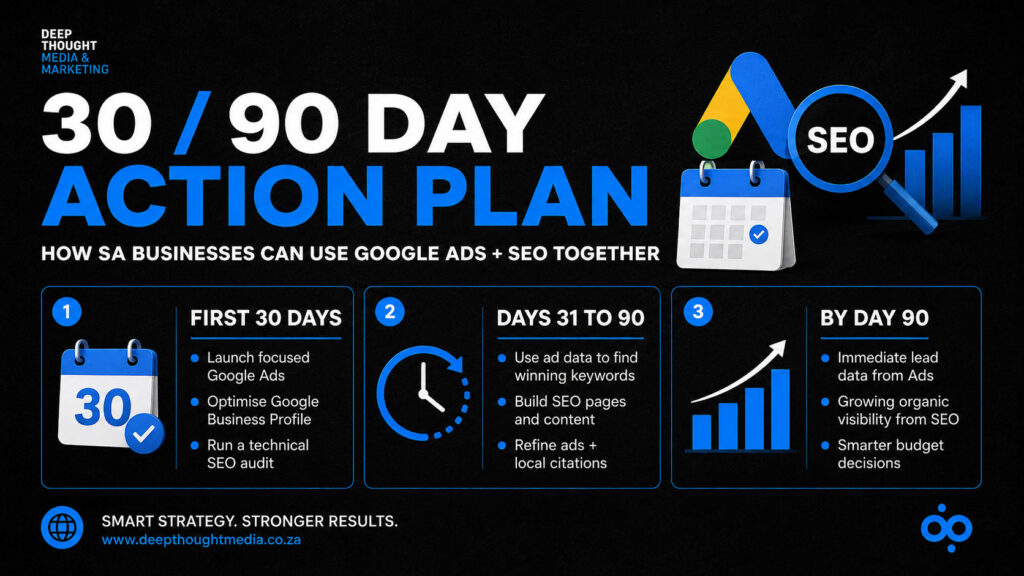
Your 30/90-Day Google Ads and SEO Action Plan
First 30 Days
- Launch a tightly scoped Google Ads campaign targeting three to five high-intent, location-specific keywords with sufficient monthly search volume for meaningful testing.
- Optimise your Google Business Profile for local search.
- Run a technical SEO audit on your existing website to identify the biggest obstacles to organic ranking.
These actions can run in parallel and do not need to wait for one another.
Days 31 to 90
- Use Google Ads conversion data to identify the top-converting keywords.
- Create SEO-optimised landing pages and content targeting those terms.
- Build local citations and relevant backlinks from reputable South African sources.
- Refine your advertising targeting based on first-month performance data.
By day 90, both channels should be running with real conversion data to guide your budget decisions for months four through twelve. At that point, you are optimising based on actual data rather than guessing.
How to Measure Whether the Strategy Is Working
Google Ads Metrics That Matter for South African SMEs
Focus on the metrics that connect advertising activity to business outcomes:
- Cost per lead rather than only cost per click
- Conversion rate by campaign and ad group
- Quality Score, which can affect both CPC and ad placement
- Return on ad spend for ecommerce businesses
Based on South African benchmark data we track across client accounts, a well-optimised campaign may achieve a cost per lead of between R150 and R800 for many service industries. If your cost per lead remains above R1,500 after 60 days of proper optimisation, something may be wrong.
The keyword targeting, landing page, offer, or tracking may need to change before additional budget is committed.
SEO Signals That Indicate Real Progress
Organic SEO metrics take longer to move, so tracking the right indicators is critical:
- Keyword ranking movements into the top 10 and top 20 positions
- Organic impressions and clicks in Google Search Console
- Organic leads or form submissions in Google Analytics
- Website authority and backlink-profile growth measured over longer periods
- Google Business Profile views, direction requests, and calls attributed to local search
If rankings are moving but leads are not, the problem may be the page’s conversion rate rather than the SEO strategy itself. Test clearer calls to action, stronger page copy, and improved layouts before concluding that organic search is not working.
So, Is Google Ads or SEO Better for Your South African Business?
There is no universal answer. Google Ads wins when speed matters, when your budget allows sufficient monthly spend, and when search intent is transactional. SEO wins when the goal is sustainable, compounding traffic that does not disappear the moment your advertising spend stops.
The real leverage comes from treating Google Ads and SEO as complementary rather than competing channels.
Use the cost benchmarks, timelines, and industry guidance in this article to make an informed first decision. If your budget allows R10,000 or more per month, running both channels from the start may be the strongest approach. If not, begin with local SEO and a tightly scoped Google Ads campaign targeting your highest-intent keywords, then scale as the data confirms what is working.
If you would rather have a team build and manage this strategy for you, Deep Thought Media & Marketing™ works with South African businesses across Cape Town and the wider market to implement integrated Google Ads and SEO strategies.
Book a free digital marketing review with Deep Thought Media, and we will give you an honest recommendation on whether Google Ads, SEO, or a combination of both makes the most sense for your business.
Frequently Asked Questions About Google Ads and SEO
Which Is Better for South African Businesses: Google Ads or SEO?
It depends on your budget, timeline, and what customers are searching for right now. Google Ads provides immediate, rented visibility, while SEO builds a compounding digital asset that can grow over time. Many South African SMEs benefit from a blended approach rather than treating the two channels as mutually exclusive.
How Much Do Google Ads Cost in South Africa?
South African CPCs vary by industry. Ecommerce clicks may average R5 to R18, home-services clicks R12 to R30, and legal-services clicks R35 to R85. A small local business may need R4,000 to R10,000 per month for meaningful volume, while growing SMEs may invest R10,000 to R25,000, with agency-management fees added separately.
What Is a Realistic Google Ads Budget for a Small Local Business?
A realistic starting point is often R4,000 to R10,000 per month in advertising spend, depending on industry competition, location, and search demand. Budget alone does not guarantee success. Campaign structure, keyword targeting, conversion tracking, landing pages, and the strength of the offer all affect results.
How Much Do SEO Retainers Cost in South Africa?
Entry-level local SEO may cost R3,000 to R8,000 per month. Small-business SEO may range from R8,000 to R18,000, while mid-market campaigns may cost R18,000 to R45,000. Enterprise SEO for highly competitive national industries can begin at R45,000 or more per month.
How Long Does SEO Take to Deliver Noticeable Results?
South African SMEs may see early ranking and impression improvements within 60 to 90 days, with more meaningful traction developing over three to six months. Strong and reliable organic lead generation commonly requires six to twelve months of consistent work, depending on the website and competition.
Should I Stop Google Ads Once My SEO Starts Ranking?
Not necessarily. Google Ads can continue capturing immediate demand, supporting promotions, and filling seasonal gaps while SEO generates organic traffic. Paid spend can be adjusted as organic visibility strengthens, but the two channels can continue supporting different goals.
How Should I Decide Between Google Ads and SEO?
Assess your budget, timeline, search demand, industry competition, and the urgency of your lead-generation needs. Use Google Ads when you need results quickly or have a time-sensitive offer. Invest in SEO when you can support a longer-term strategy designed to build sustainable visibility. A blended approach can capture immediate traffic while building organic authority.